Nice to see you.


Order Lone Wolf World via Amazon or above
2018 Best New Talent - Short and Sweet Festival Sydney
2014 Pushcart Prize nominee. (more)

Books:


Get a weekly post delivered straight to your email. Email Subscribe to anthonyjlangford2@yahoo.com.au

Categories

Showing posts with label The Eighth Wonder of the World. Show all posts

The Eighth Wonder of the World - Incredible! (Last in this Series)


 Eighth Wonder of the World

There are a few considered for the title.
Four are listed here. They are constructions rather than natural wonders.

Pre-1900 creations


Part Eight


The Taj Mahal


The Taj Mahal  'Crown of the Palace') is an ivory-white marble mausoleum on the bank of the river Yamuna in AgraUttar Pradesh, India. It was commissioned in 1631 by the fifth Mughal emperorShah Jahan (r. 1628–1658) to house the tomb of his beloved wife, Mumtaz Mahal; it also houses the tomb of Shah Jahan himself. The tomb is the centrepiece of a 17-hectare (42-acre) complex, which includes a mosque and a guest house, and is set in formal gardens bounded on three sides by a crenellated wall.

Construction of the mausoleum was completed in 1648, but work continued on other phases of the project for another five years. 


There are many myths surrounding it, including that it was actually built in the 12th century. That it was designed by a Frenchman, another claims a Spaniard, an Italian and another by a Hindu King. No concrete evidence exists for claims that describe, often in horrific detail, the deaths, dismemberment and mutilations which Shah Jahan supposedly inflicted on various architects and craftsmen associated with the tomb.


Photo - Muhammad Mahdi Karim - Own work, GFDL 1.2, https://commons.wikimedia.org/w/index.php?curid=23199927


The Taj Mahal is a major tourist attraction and attracts approximately five million visitors a year.


                                                    The Terracotta Army

The Terracotta Army is a collection of terracotta sculptures depicting the armies of Qin Shi Huang, the first emperor of China. It is a form of funerary art buried with the emperor in 210–209 BCE with the purpose of protecting him in his afterlife.

The figures, dating from approximately the late 200s BCE, were discovered in 1974 by local farmers.


GFDL, CC BY-SA 3.0, https://commons.wikimedia.org/w/index.php?curid=2103826


The figures vary in height according to their rank, the tallest being the generals. The figures include warriors, chariots and horses. Estimates from 2007 were that the three pits containing the Terracotta Army hold more than 8,000 soldiers, 130 chariots with 520 horses, and 150 cavalry horses. Other, non-military figures have since been found in other pits, including those of officials, acrobats, strongmen, and musicians.


By kevinmcgill from Den Bosch, Netherlands - KAM_5048, CC BY-SA 2.0, https://commons.wikimedia.org/w/index.php?curid=31690639


                                                        The Thames Tunnel


The Thames Tunnel is a tunnel beneath the River Thames in London, connecting Rotherhithe and Wapping. It measures 35 ft (11 m) wide by 20 ft (6.1 m) high and is 1,300 ft (400 m) long, running at a depth of 75 ft (23 m) below the river surface measured at high tide. It is the first tunnel known to have been constructed successfully underneath a navigable river. It was built between 1825 and 1843 by Marc Brunel, and his son, Isambard.


The tunnel was originally designed for horse-drawn carriages, but was mainly used by pedestrians and became a tourist attraction. In 1869 it was converted into a railway tunnel.


By Lars Plougmann from United States - Thames Tunnel walk, CC BY-SA 2.0, https://commons.wikimedia.org/w/index.php?curid=11606054


Previous entries HERE


Bonus - One more for the simple thrill of it. This is the Victoria Bridge in Montreal, Canada. It opened in 1859 and spans the St. Lawrence River. 

Human beings can be quite amazing afterall!


Photo 1901


This is the last in this series. I hope you enjoyed them. 

Peace
Anthony


The Eighth Wonder of the World - Part 7


 Eighth Wonder of the World

There are a few considered for the title.
Three are listed here. They are constructions rather than natural wonders.

Pre-1900 creations


Part Seven


Sigiriya 

Sigiriya or Sinhagiri (Lion Rock) is an ancient rock fortress located in the northern Matale District in Sri Lanka. It is a site of historical and archaeological significance that is dominated by a massive column of granite approximately 180 m (590 ft) high.


By Binuka poojan - Own work, CC BY-SA 4.0, https://commons.wikimedia.org/w/index.php?curid=90567505


It is likely that the area around Sigiriya was inhabited since prehistoric times. There is clear evidence that the many rock shelters and caves in the vicinity were occupied by Buddhist monks and ascetics from as early as the 3rd century BC.


By dronepicr - Sigiriya Luftbild, CC BY 2.0, https://commons.wikimedia.org/w/index.php?curid=52016328


In 477 AD, Kashyapa I, seized the throne from King Dhatusena, following a coup. The rightful heir, Moggallana, fearing for his life, fled to South India. Afraid of an attack by Moggallana, Kashyapa moved the capital and his residence to the more secure Sigiriya. 

During King Kashyapa’s reign (477 to 495 AD), Sigiriya was developed into a complex city and fortress. Most of the elaborate constructions on the rock summit and around it, including defensive structures, palaces, and gardens, date from this period.


By Cherubino - Own work, CC BY-SA 3.0, https://commons.wikimedia.org/w/index.php?curid=30088456


The site contains the ruins of an upper palace located on the flat top of the rock. The lower palaces clings to the slopes below the rocks. The moats, walls and gardens of the palace extended for a few hundred metres from the base of the rock. The site was both a palace and a fortress. The upper palace on the top of the rock includes cisterns cut into the rock.


Statue of Liberty


The copper statue, a gift from the people of France, was designed by French sculptor Frédéric Auguste Bartholdi and its metal framework was built by Gustave Eiffel. The statue was built in France, shipped overseas in crates, and assembled on the completed pedestal on what was then called Bedloe's Island.
The statue was dedicated on October 28, 1886.


By User:Mcj1800 - Own work, CC BY-SA 4.0, https://commons.wikimedia.org/w/index.php?curid=84048565


I went there in 1990. You've probably been yourself. You can walk up inside and look out through the crown (or was it the eyes?) It was a long time ago now. Went up the Twin Towers the next day and stood on the roof. Watching Sept. 11 2001 happen live was horrific.


Stonehenge


www.flickr.com/photos/garethwiscombe/1071477228/in/photostream/, CC BY 2.0


Archaeologists believe that Stonehenge was constructed in several phases from around 3100 BC to 1600 BC, with the circle of large sarsen stones placed between 2600 BC and 2400 BC. The surrounding circular earth bank and ditch, which constitute the earliest phase of the monument, have been dated to about 3100 BC. Radiocarbon dating suggests that the bluestones were given their current positions between 2400 and 2200 BC, although they may have been at the site as early as 3000 BC.


The oldest known depiction of Stonehenge, from the second quarter of the 14th century. A giant helps Merlin build Stonehenge.


Many aspects of Stonehenge, such as how it was built and for what purposes it was used, remain subject to debate.

I went there in 1989. You could get much closer to it then than now. You've probably been there too. Not a lot to see, or wasn't then. ie no tourist centre. Or is memory failing me again? 
Still very interesting however and Bath is nearby, which is historically fascinating.


More in this Series HERE 


The Eighth Wonder of the World - Amazing! Part 6


 Eighth Wonder of the World

There are a few considered for the title.
Three are listed here. They are constructions rather than natural wonders.

Pre-1900 creations


Part Six


Church of Saint George, Lalibela


The Church of Saint George is one of eleven rock-hewn monolithic churches in Lalibela, a town in the Amhara Region of Ethiopia.


Church of St. George, rock-hewn in the shape of a cross

Sailko - Own work, CC BY 3.0, https://commons.wikimedia.org/w/index.php?curid=89991617


The Church of Saint George was carved downwards from a type of volcanic tuff. This is the sole architectural material that was used in the structure. It has been dated to the late 12th or early 13th century AD. It is among the best known and last built of the eleven churches in the Lalibela area, and has been referred to as the "Eighth Wonder of the World".

Lalibela, King of Ethiopia, sought to recreate Jerusalem, and structured the churches' landscape and religious sites in such a way as to achieve such a feat.


From above. Bete Giyorgis (Church of St. George) from above, one of the rock-hewn churches of Lalibela


On first approach the site appears wholly inaccessible, with sheer drops on every side and no access bridge. It is accessed via a very narrow man-made canyon, spiralling downwards, which changes to a tunnel close to the church, to further conceal its presence.


Royal Palace of Amsterdam


The Royal Palace of Amsterdam in Amsterdam (Dutch: Koninklijk Paleis van Amsterdam or Paleis op de Dam) is one of three palaces in the Netherlands which are at the disposal of the monarch by Act of Parliament.


The palace was built as a city hall during the Dutch Golden Age in the 17th century. The building became the royal palace of King Louis Napoleon and later of the Dutch Royal House.


Superchilum - Own work, CC BY-SA 4.0, https://commons.wikimedia.org/w/index.php?curid=72314780


The structure was built as the Town Hall of the City of Amsterdam "facing the landing wharfs along Damrak, which at that time would have been busy with ships". The town hall was opened on 29 July 1655 by Cornelis de Graeff, the mayor of Amsterdam.  

The main architect was Jacob van Campen, who took control of the construction project in 1648. It was built on 13,659 wooden piles.
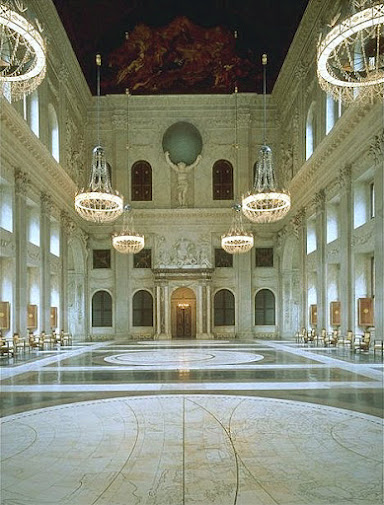


The Central Hall


Polhem dry dock


Polhem dry dock, is situated in the World heritage Örlogsstaden Karlskrona, was built in 1717–1724 and was the first dry dock in Sweden. It is cut out in the cliff on Lindholmen island and catered for shipping including the largest warships of its day.


While dry docks in other countries where let dry by the tidal water going out, in this dock water pumps are used, as the Baltic Sea doesn't have any significant tide. The dry dock was built by 600 men and was an international sensation for its advanced design.


Boatbuilder - Own work, CC BY-SA 3.0, https://commons.wikimedia.org/w/index.php?curid=11109009


The drydock has its name from Christopher Polhem, who constructed it. It is described as the Eighth Wonder of the World by the Karlskrona shipyard history association. The water pumps were created by the shipbuilding master Charles Sheldon, they were of a kind already used in Swedish mines. Before converting to steam power in the 19th century around 100 men were required to power the pumps


More in this Series HERE


https://anthonyjlangford.wixsite.com/writer/books


'Eighth Wonders of the World.' Part 5 - These are amazing


 Eighth Wonder of the World

There are a few considered for the title.
Three are listed here. They are constructions rather than natural wonders.

Pre-1900 creations


Part Five


Macchu Picchu


Machu Picchu is a 15th-century Inca citadel located in southern Peru on a 2,430-meter (7,970 ft) mountain ridge.

The Inca civilization had no written language and, after the discovery by a Spanish soldier Baltasar Ocampo, by the end of the 16th-century no more Europeans visited the site until the 19th century.


Photo from 2007


The names of the buildings, their supposed uses, and their inhabitants are the product of modern archaeologists based on physical evidence, including tombs at the site

Most of the outlying buildings have been reconstructed in order to give visitors a better idea of how they originally appeared.


1912 after major clearing and before reconstruction work began


Most recent archaeologists believe that Machu Picchu was constructed as an estate for the Inca emperor Pachacuti (1438–1472). The Incas built the estate around 1450 but abandoned it a century later, at the time of the Spanish conquest. According to radiocarbon dating, it was occupied from c. 1420–1532.


Temple of the Sun or Torreon


During its use as a royal estate, it is estimated that about 750 people lived there, with most serving as support staff. Since its rediscovery in 1911, growing numbers of tourists have visited the site each year, with numbers exceeding 1.4 million in 2017.


Moai


Moai are monolithic human figures carved by the Rapa Nui people on Rapa Nui (Easter Island) in eastern Polynesia between the years 1250 and 1500. 


By Ian Sewell - IanAndWendy.com Photo gallery from Easter Island, CC BY 2.5, https://commons.wikimedia.org/w/index.php?curid=1193567


Nearly half are still at Rano Raraku, the main moai quarry, but hundreds were transported from there and set on stone platforms called ahu around the island's perimeter. Almost all moai have overly large heads, which comprise three-eighths the size of the whole statue and they have no legs. The moai are chiefly the living faces of deified ancestors. 


The statues still gazed inland across their clan lands when Europeans first visited the island in 1722, but all of them had fallen by the latter part of the 19th century. The moai were toppled in the late 18th and early 19th centuries, possibly as a result of European contact or internecine tribal wars.

There are approx. 900 statues. They are still being discovered as of 2023.


Obelisk of Axum


The Obelisk of Axum is a 4th-century CE, 24-metre (79 ft) tall phonolite stele, weighing 160 tonnes  in the city of Axum in Ethiopia.


By I, Ondřej Žváček, CC BY 2.5, https://commons.wikimedia.org/w/index.php?curid=6027150


Erection of stelae in Axum was a very old practice. Their function is supposed to be as markers for underground burial chambers. The largest of the grave markers were for royal burial chambers and were decorated with multi-story false windows and false doors, while lesser nobility would have smaller, less decorated ones. While there are only a few large ones standing, there are hundreds of smaller ones in various "stelae fields".


The Obelisk at Axum in 1805


It was taken to Italy in 1937 as war booty. It was agreed to return it in 1961 but took until 2005 to do so fully due to the difficulty and cost involved.


The Northern Stelae Park in Axum, with the King Ezana's Stele at the centre and the Great Stele lying broken.

By Jialiang Gao www.peace-on-earth.org - Original Photograph, CC BY-SA 3.0, https://commons.wikimedia.org/w/index.php?curid=543948


More in this Series.


Hope you have a good week. If you like anything that you see, please share or let me know as feedback lets me know someone is reading.

Cheers
Peace

Anthony


The Eighth Wonder of the World - Part Four


 Eighth Wonder of the World

There are a few considered for the title.
Three are listed here. They are constructions rather than natural wonders.

Pre-1900 creations


Part Four


Great Wall of China


By Jakub Hałun - Own work, CC BY-SA 3.0, httpscommons.wikimedia.orgwindex.phpcurid=6909926


The Great Wall of China is a series of fortifications that were built across the historical northern borders of ancient Chinese states and Imperial China as protection against various nomadic groups from the Eurasian Steppe. Several walls were built from as early as the 7th century BC, with selective stretches later joined by Qin Shi Huang (220–206 BC), the first emperor of China. Little of the Qin wall remains. 


1907

Later on, many successive dynasties built and maintained multiple stretches of border walls. The best-known sections of the wall were built by the Ming dynasty (1368–1644).

A controversial question is whether the wall is visible from low Earth orbit (an altitude of as little as 160 km (100 mi)). NASA claims that it is barely visible, and only under nearly perfect conditions; it is no more conspicuous than many other human-made objects.


By Severin.stalder, CC BY-SA 3.0, https://commons.wikimedia.org/w/index.php?curid=39661035


Kinzua Bridge


The Kinzua Bridge or the Kinzua Viaduct was a railroad trestle that spanned Kinzua Creek in McKean County in the U.S. state of Pennsylvania. The bridge was 301 feet (92 m) tall and 2,052 feet (625 m) long. Most of its structure collapsed during a tornado in July 2003.


The original Kinzua Bridge, before its reconstruction in 1900


Billed as the "Eighth Wonder of the World", the wrought iron original 1882 structure held the record for the tallest railroad bridge in the world for two years. In 1900, the bridge was dismantled and simultaneously rebuilt out of steel to allow it to accommodate heavier trains. 


Restoration of the bridge began in 2002, but before it was finished a tornado struck the bridge in 2003, causing a large portion of the bridge to collapse. 


The Leaning Tower of Pisa 


The Leaning Tower of Pisa is freestanding bell tower, of Pisa Cathedral. It is known for its nearly four-degree lean, the result of an unstable foundation. The tower is one of three structures in the Pisa's Cathedral Square (Piazza del Duomo), which includes the cathedral and Pisa Baptistry.


By Arne Müseler / www.arne-mueseler.com, CC BY-SA 3.0 de,
https://commons.wikimedia.org/w/index.php?curid=116752074


The height of the tower is 55.86 metres (183 feet 3 inches) on the low side and 56.67 m (185 ft 11 in) on the high side. The tower has 296 or 294 steps.

The tower began to lean during construction in the 12th century, due to soft ground which could not properly support the structure's weight. Construction of the tower occurred in three stages over 199 years.  It worsened through the completion of construction in the 14th century. By 1990, the tilt had reached 5.5 degrees.

I visited it in 1989. Walking up it's spiral staircase was a bizarre experience. You went up on one side and it felt like you were going down on the other. 


By Arne Müseler / www.arne-mueseler.com, CC BY-SA 3.0 de, https://commons.wikimedia.org/w/index.php?curid=116752044


Galileo Galilei, who lived in Pisa at the time, is said to have dropped two cannonballs of different masses from the tower to demonstrate that their speed of descent was independent of their mass, in keeping with the law of free fall. 

The structure was stabilized by remedial work between 1993 and 2001, which reduced the tilt to 3.97 degrees.


More in this Series


Next week, that crazy Flaw Finding Phil. A video/audio story.


Have a great week
Peace.